










Between 50 and 100 students, fee payments and parent messages roughly double and one teacher’s evenings fill up. The first thing to break is usually the owner’s memory, not the teaching. Write down each process (enquiries, admissions, fees, attendance, make-ups and batch capacity) and give it an owner before you hire.
1. See the step change in numbers
With about 14 students a batch and 2 classes a week per batch:
| 50 students | 100 students | |
|---|---|---|
| Batches | 4 | 7–8 |
| Classes a week | 8 | 14–16 |
| Fee payments a month | about 50 | about 100 |
| Parents to keep informed | about 50 families | about 100 families |
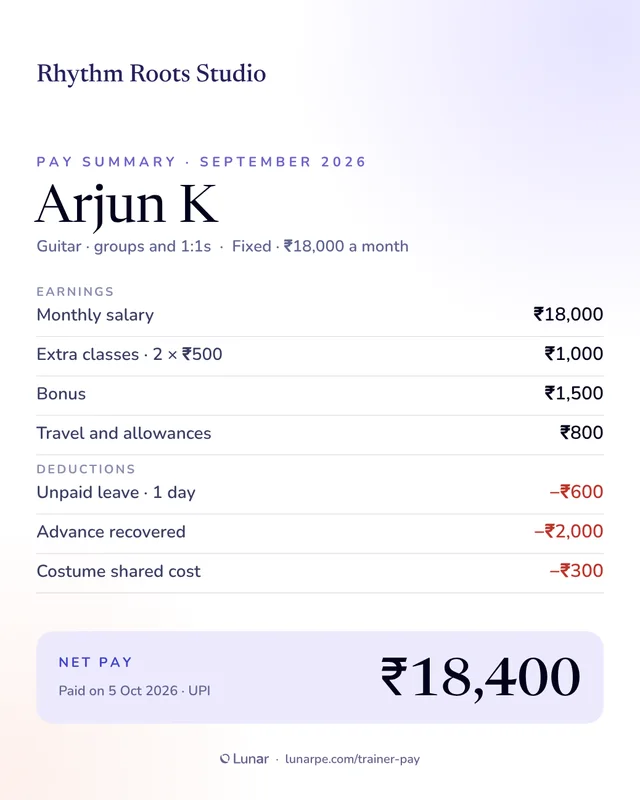
A weekday evening from 4 to 8 PM holds about 4 one-hour slots, or about 20 a week. At 100 students, one teacher's evenings are nearly full. That is usually when a second trainer or a weekend timetable becomes necessary (the free trainer pay calculator handles mixed pay types), and when the owner stops being able to do everything personally.
2. Listen for the bottleneck
- "Ask me before changing anything."
- "Let me check my WhatsApp."
- "I think they've paid."
- "Only I know which batch she's in."
These aren't signs of a bad academy. They're signs that information still lives with the owner instead of with the academy.
3. Standardise before you hire
Hiring an administrator before the processes are clear just means more people asking the owner questions. Write each process down, give it an owner, then hire or add software around it.
4. Copy this: the 50-to-100 checklist
- Every enquiry is recorded in one place, with a next step and a date
- Admission has the same steps for every family (Guide 7)
- Every fee has a due date and a state (Guide 1)
- Reminders go out on a fixed cadence (Guide 2)
- Attendance is marked in every class, by whoever teaches it
- Breaks and make-ups follow a written policy (Guide 4)
- Each batch has a target capacity and you know its utilisation (Guide 5)
- Schedule changes are sent by one named person
- Student progress (levels, exams, performances) is recorded outside anyone's memory
5. The goal isn't more administration
Growth should let you teach more students, not spend every evening reconciling spreadsheets and WhatsApp threads. Good systems are almost invisible: the academy gets bigger without getting proportionally harder to run.
 Academy Guides · Growth · 3 min readHow full should a batch be? A practical capacity guide
 Academy Guides · Admissions · 3 min readFrom trial class to enrolled student: building a better admission journey
 Free toolTrainer pay calculator